


Watercolour Success, watercolour failure, or perceived failure of self?

Can you make corrections to a watercolour? In short, yes is the answer! I frequently have conversations with students who somehow believe that a watercolour is a one way process and if something goes wrong, you cannot change it. And not only that, the belief extends particularly to applying darks - "I'm really scared to put in the dark because if it goes wrong, it won't come off."
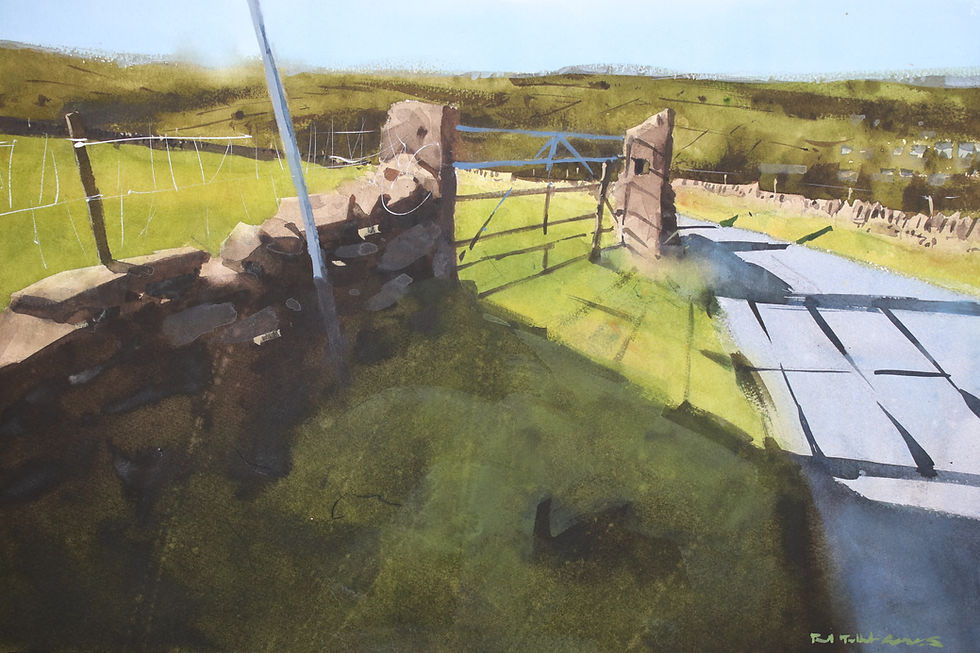
This painting has had an extensive correction made to it. Can you see it? Read on for more details.
"When I was at school I was told never to paint again, and even though I have wanted to, I've not painted since."
Well, first let's dispel this myth. Watercolour is pigment held together by gum Arabic and maybe some glycerine. It is essentially water soluble, so it makes no difference whether there is a thin application or a heavy, dark application of colour. It is still going to be removable. What does make a difference though is the method of removal. To avoid staining the paper further or spreading colour beyond the correction area, it pays to work methodically and cleanly, and this is where most people leave technique behind.
Leaving paint removal aside and delving into the mind for a minute, if a painting is not working we are essentially dealing with momentary failure, and many of us are life conditioned to believe that failure is bad. Psychologically, seeing a correction as failure, maybe as a failure of ability, or even a failure of self, is likely to be interpreted on a negative bias, and in a painting context, this can lead to behaviour such as self sabotage or hopelessness. It can lead us to believe that any further action will not work for us, that maybe we somehow failed on the painting because we're not good enough. If this is the case, it can often stem from childhood experiences and in conversations with adult learners, I am frequently told the same story - "When I was at school I was told by my teacher never to paint again, and even though I have wanted to, I've not painted since."
If we left our childhood self holding the paintbrush all those years ago, in the belief that we cannot paint, then in moments of adult painting failure, the mini you steps back in. Anyone working with children in a creative setting will at some point witness tears, disruptive behaviour, or destruction of work when a child is frustrated or negatively compares their ability to others around them. I see the same reactions in my adult workshops - artists hopelessly scrubbing a correction into destruction. Paintings go in the bin, get screwed up or disposed of in an attempt to distance oneself from the childhood pain of failure. There are sometimes tears too. In these workshops, I've pulled numerous half paintings from studio bins and finished them for the student, demonstrating with kindness, understanding, and practicality, how the painting could have been progressed through the application of a few brush strokes or values. These are often epiphany moments for the learner.
What is interesting about failure is that whilst we wriggle and writhe in its presence, it is an essential part of creativity.
The painting (left) lost its way and became heavy and messy with too much paint and the addition of gouache. At this point I decided to wash off the entire foreground and some of the middle ground. There was so much colour, it went under the tap!
What is interesting about failure is that whilst we wriggle and writhe in its presence, it is an essential part of creativity. Without failure there is no progression. As an artist it is really important to accept failure as part of the practise, not in a 'shrug your shoulders and start again' kind of way, but to be more mindful of our ability, to pause and think. Why did it not work this time? How can I make that better for me next time? Did it not work for me because it involved a weakness of mine? What steps should I take to help remedy this? So if you reach a point of wanting to destroy your painting, the first thing to do is to leave it alone and take a time out from the work space. Think a little. Try to work out or imagine how it might be improved. Over time, this can help build further knowledge and creative ideas that might inspire you to be more positive about making corrections.
For drastic changes or large areas it can be beneficial to run the painting, or part of the painting under the tap.
Areas of the middle distance were also scrubbed out and dried before the foreground shadow was repainted.
So, back to the method. The first part of correcting a watercolour is to remove the paint. The success of this correlates with the type of paper you are using, and also, the level of size that is used in its production. Cellulose papers tend to release colour easier than cotton papers, which tend to stain more. Nevertheless, it is entirely possible to remove enough paint to leave a light stain that can be overpainted in the repair. Don't rush this bit, because it needs patience and positive expectation. It can be helpful to first, spray the repair area and just beyond, with a diffuser spray. To make the correction, use plenty of clean water, a stiff brush like a hogs hair brush or decorator brush, and paper towels. Gently scrub a small area of your dampened surface until paint begins to lift. Dab it gently with paper towel then clean your brush and repeat. Keep using fresh paper towel to avoid stamping colour back on to the painting. You must refresh your water frequently, but with perseverance you will cleanly remove the paint and that will allow you to rework the area. For drastic changes or large areas it can be beneficial to run the painting, or part of the painting under the tap.
By using bright colour, the light on the fields was re established, even though the paper was stained.
Once the paint is removed the paper must be thoroughly dried before repainting. And if it doesn't work this time? Well you will have at least learned that making corrections are possible and in turn, this might help you relax more in a future painting session.
If you enjoyed this post, you will find more helpful content on my Instagram page.


Paul Talbot-Greaves RI, Artist, Author, Tutor
Paul Talbot-Greaves is a member of the Royal Institute Of Painters In Watercolours, and has been painting and writing for 30 years. He writes many articles for The Artist magazine (UK), has four practical art books published and has contributed to various others. He is represented by numerous galleries based around the North of England. He can be found on Instagram and Facebook where he regularly posts up to date pieces and inspirational stories.


Comments